Skip to content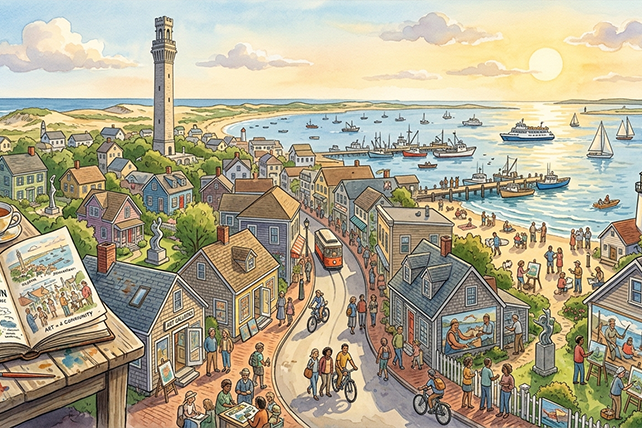
There are places you visit, and then there are places that quietly rearrange how you see the world. Provincetown falls into the second category. Tucked at the very tip of Cape Cod, it carries a kind of layered identity that feels both deeply rooted and constantly evolving.
That’s exactly what the book Provincetown: A Unique Sense of Place by Marcene Marcoux sets out to explore, and it does so with a surprising amount of intimacy. This isn’t just another local history. It feels closer to sitting down with someone who has lived there long enough to notice the small, telling details.
The way light hits the harbor in late afternoon. The mix of artists, fishermen, wanderers, and long-time residents somehow coexist without flattening each other out.
What Makes Provincetown ‘Provincetown?’
More Than a Postcard Setting
It would be easy to reduce Provincetown to pretty beaches and colorful streets. Plenty of places have those. What the book Provincetown: A Unique Sense of Place captures instead is the tension between permanence and change.
You get glimpses of a working town that refuses to become a museum piece. Fishing traditions still matter. So, do the galleries. So, does the seasonal rhythm, where summer brings energy and winter pulls everything inward.
There’s a question that lingers while reading. How does a place stay itself when so many people pass through it?
A Community Built on Difference
One of the more compelling threads in Provincetown: A Unique Sense of Place is how diversity isn’t treated as a buzzword. It’s just reality. Artists, LGBTQ+ communities, writers, and locals with generations of history all shape the town in visible ways.
And it’s not always tidy. Communities like this rarely are. There’s friction. There’s overlap. But there’s also a shared understanding that difference is part of the foundation, not a challenge to it.
That perspective gives the book a kind of honesty that’s hard to fake.
The Artistic Pulse Beneath It All
Where Creativity Feels Lived-In
Provincetown has long been associated with art, but Provincetown: A Unique Sense of Place doesn’t treat creativity as something reserved for galleries. It shows up in daily life, making it one of the best books to read.
You sense it in how spaces are used in conversations. In the way people talk about the town itself, almost like it’s a collaborator rather than just a setting. There’s something refreshing about that. Art here isn’t elevated above life. It’s tangled up in it.
Stories That Don’t Feel Polished
Another strength of the book, Provincetown: A Unique Sense of Place, is its tone. It doesn’t smooth everything out for the sake of narrative neatness. Instead, it leans into the slightly uneven, human side of storytelling.
Moments feel observed rather than staged. You can almost picture the scenes unfolding without someone stepping in to “fix” them for readability. That choice makes the book feel grounded. Real, in a way that sticks.
Why This Book Resonates
A Sense of Place That Feels Earned
The phrase “sense of place” gets thrown around a lot, often without much depth behind it. Here, it actually means something. The book, Provincetown: A Unique Sense of Place, builds that sense gradually, through layers of observation rather than sweeping statements.
You start to understand how geography, history, and people interact, not as separate elements, but as something intertwined. It’s subtle. And it works.
For Readers Who Like to Look Closer
This isn’t a fast read in the sense of plot-driven momentum. It’s the kind of book you linger with. Provincetown: A Unique Sense of Place rewards attention, especially if you enjoy noticing the small things that define a place.
It’s particularly appealing for readers who have an interest in small towns that carry a larger cultural weight. Or for anyone who has ever wondered what makes certain places feel alive while others feel staged.
A Quietly Lasting Impression
By the time you finish the book, Provincetown: A Unique Sense of Place, there’s a shift. Not a dramatic one, but noticeable. You start thinking about the place differently. About how communities form, stretch, adapt, and sometimes resist definition altogether.
It doesn’t try to tie everything up neatly. That’s part of its strength. Provincetown remains a little elusive, even at the end, which feels right. Some places are better understood in layers, not summaries. And Marcoux does a spectacular job of showcasing that.